Telegram Business Ecosystem: More Than a Chatbot
Telegram as a business operating system: order intake, state machine, atomic operations, role-based routing and CRM/ERP integrations — zero hardware investment, launch in days.
// Technologies
What it is
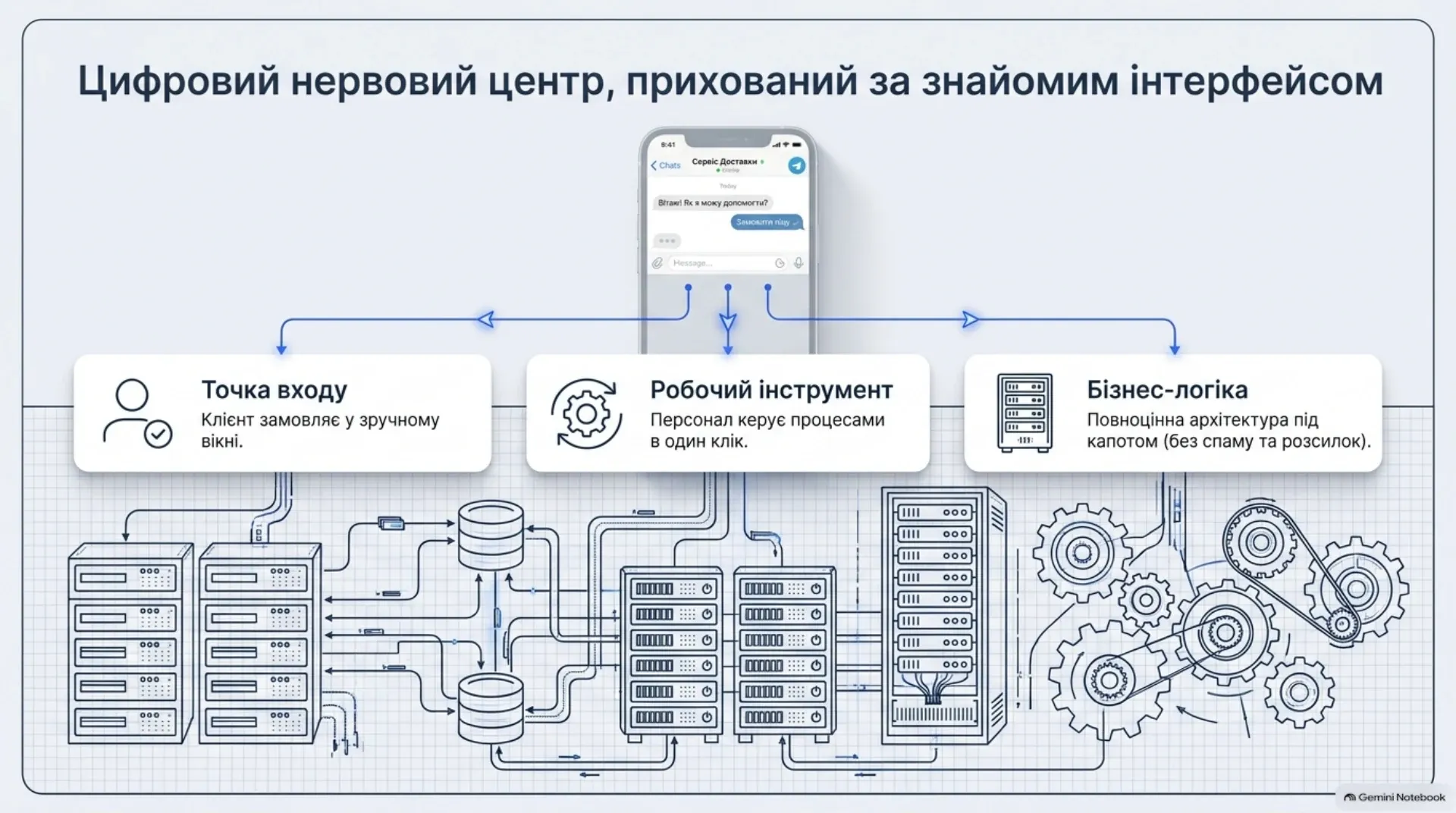
We turn Telegram into a full business operating system — not «just another chatbot», but a digital core where the customer places an order, staff run the processes, and the owner sees analytics. It all works inside a familiar messenger already installed on your customers’ and employees’ phones, with no separate apps, spam or mailouts.
Key numbers
- Zero hardware investment — the system runs on smartphones staff already own. No terminals, tablets or POS stations required.
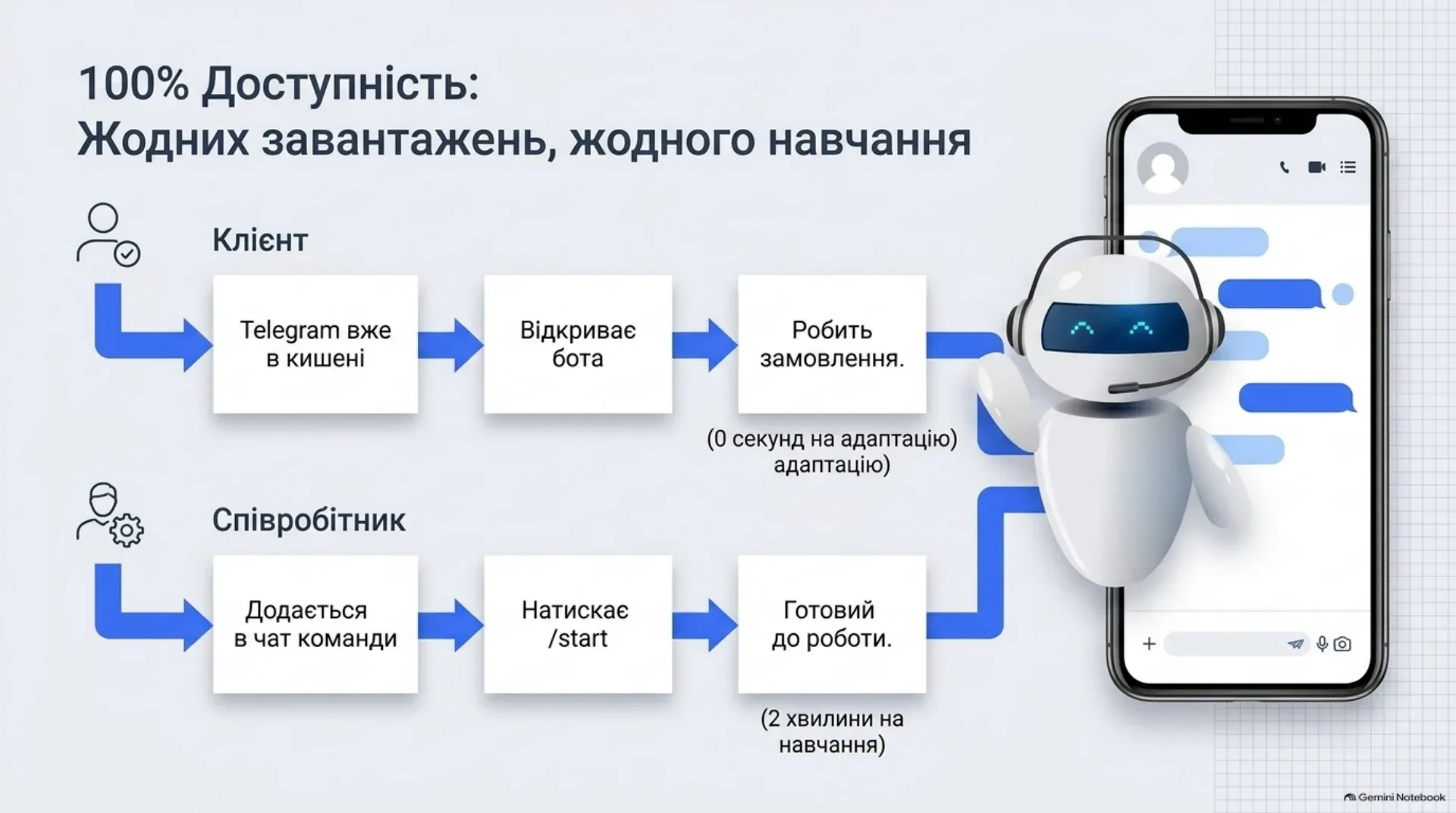
- ~0 seconds of customer onboarding — Telegram is already in the pocket, nothing to install.
- ~2 minutes to train an employee — processes are driven by inline buttons, with no complex text commands.
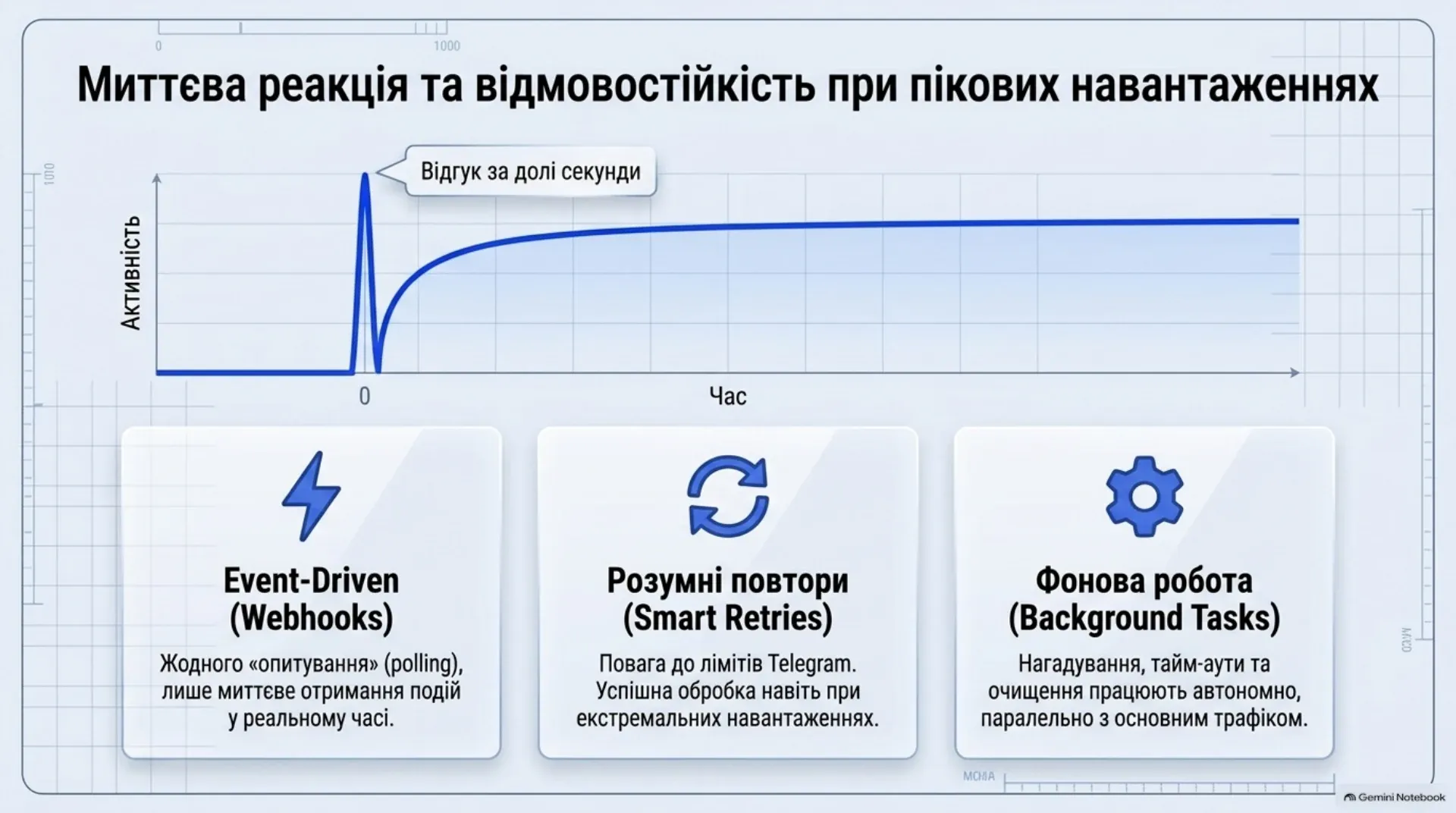
- Response in fractions of a second — an event-driven webhooks model instead of slow polling, stable even under peak load.
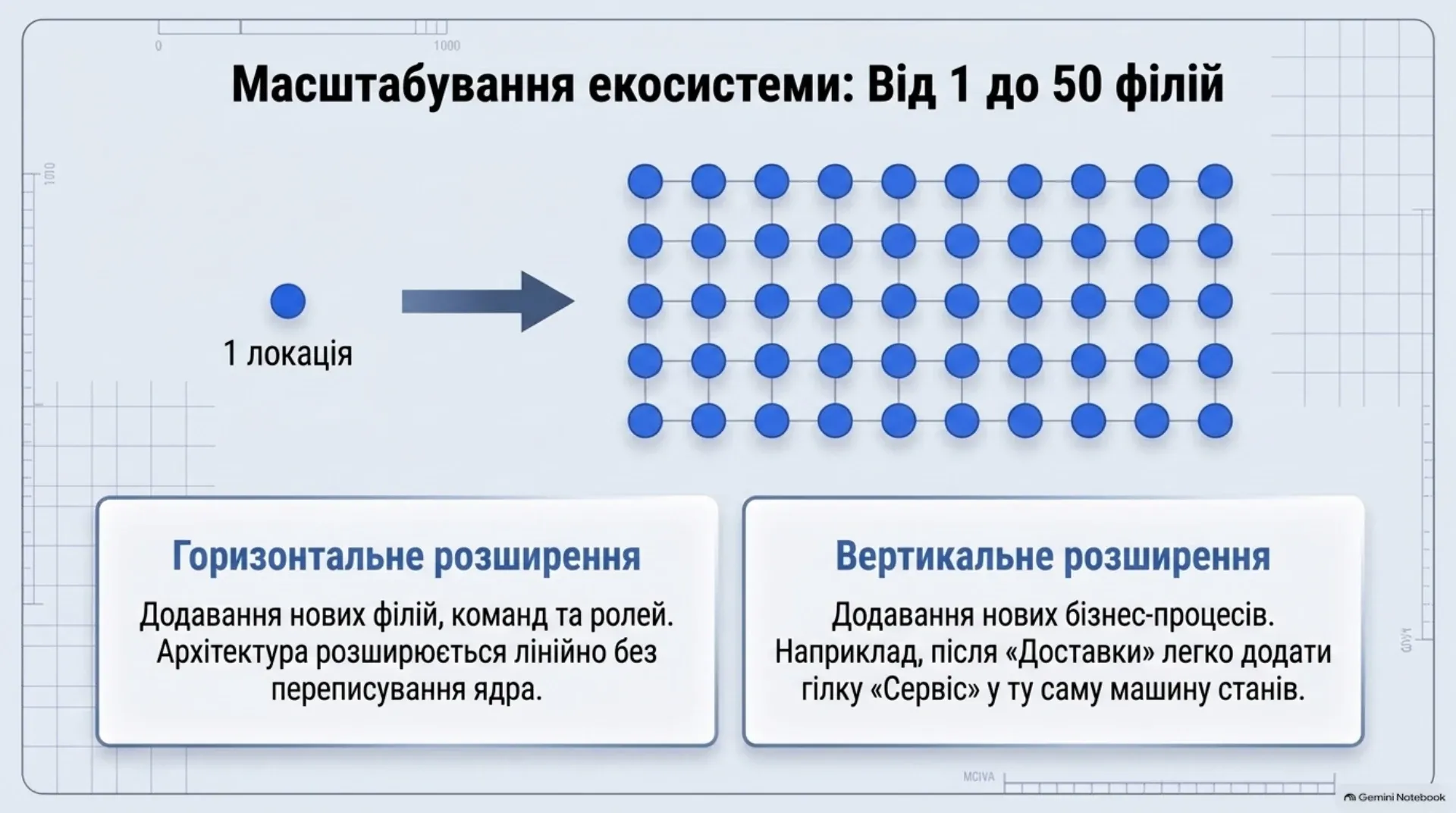
- From 1 to 50+ branches — a single core scales linearly without rewriting the architecture.
- 3 rollout stages and 4 industries out of the box — HoReCa, Retail & E-commerce, logistics, service desk.
How it works
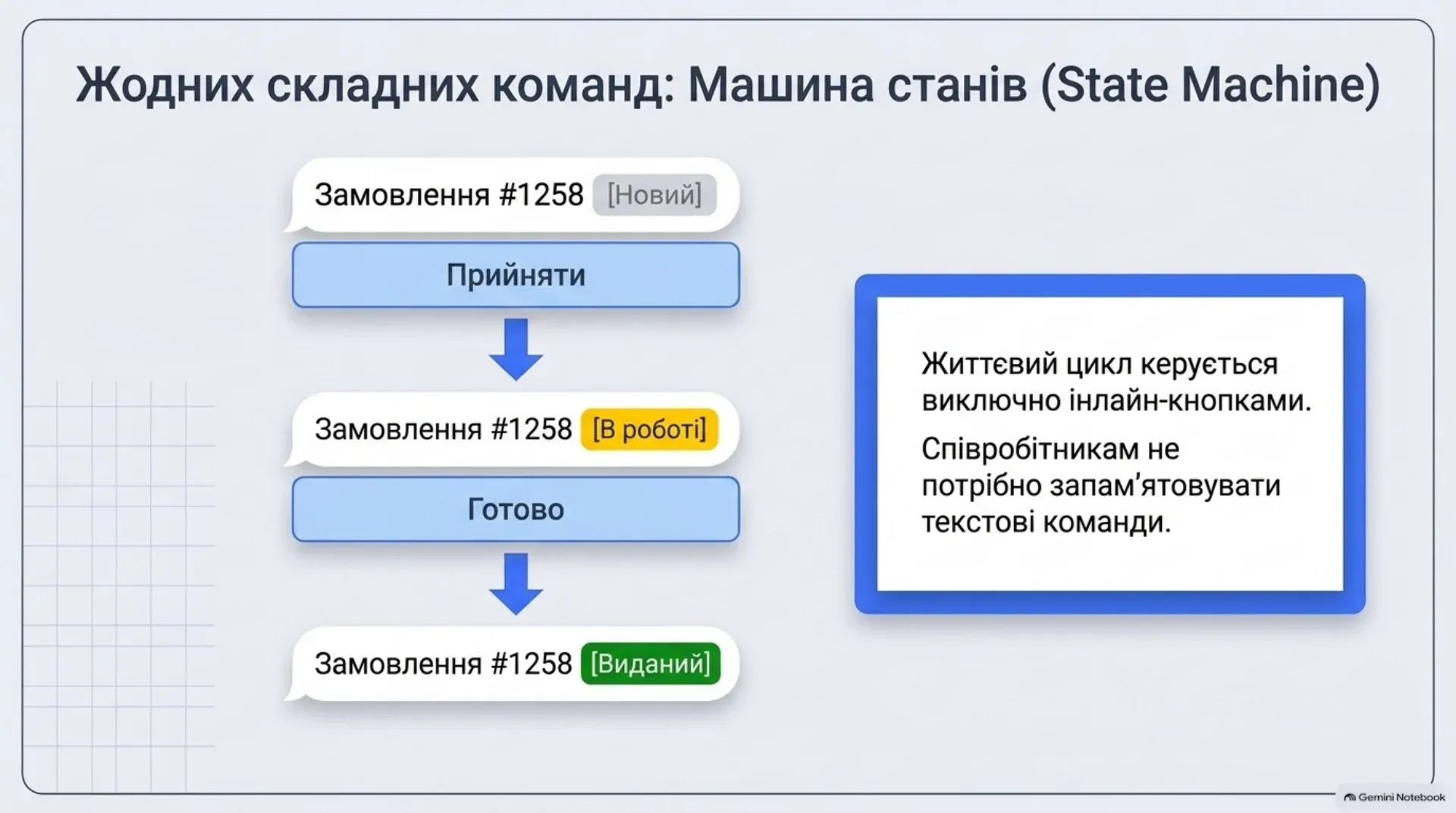
State Machine. The order lifecycle is driven purely by inline buttons: «Accept» → «In progress» → «Delivered». Staff never memorize commands, and the system never loses track of statuses.
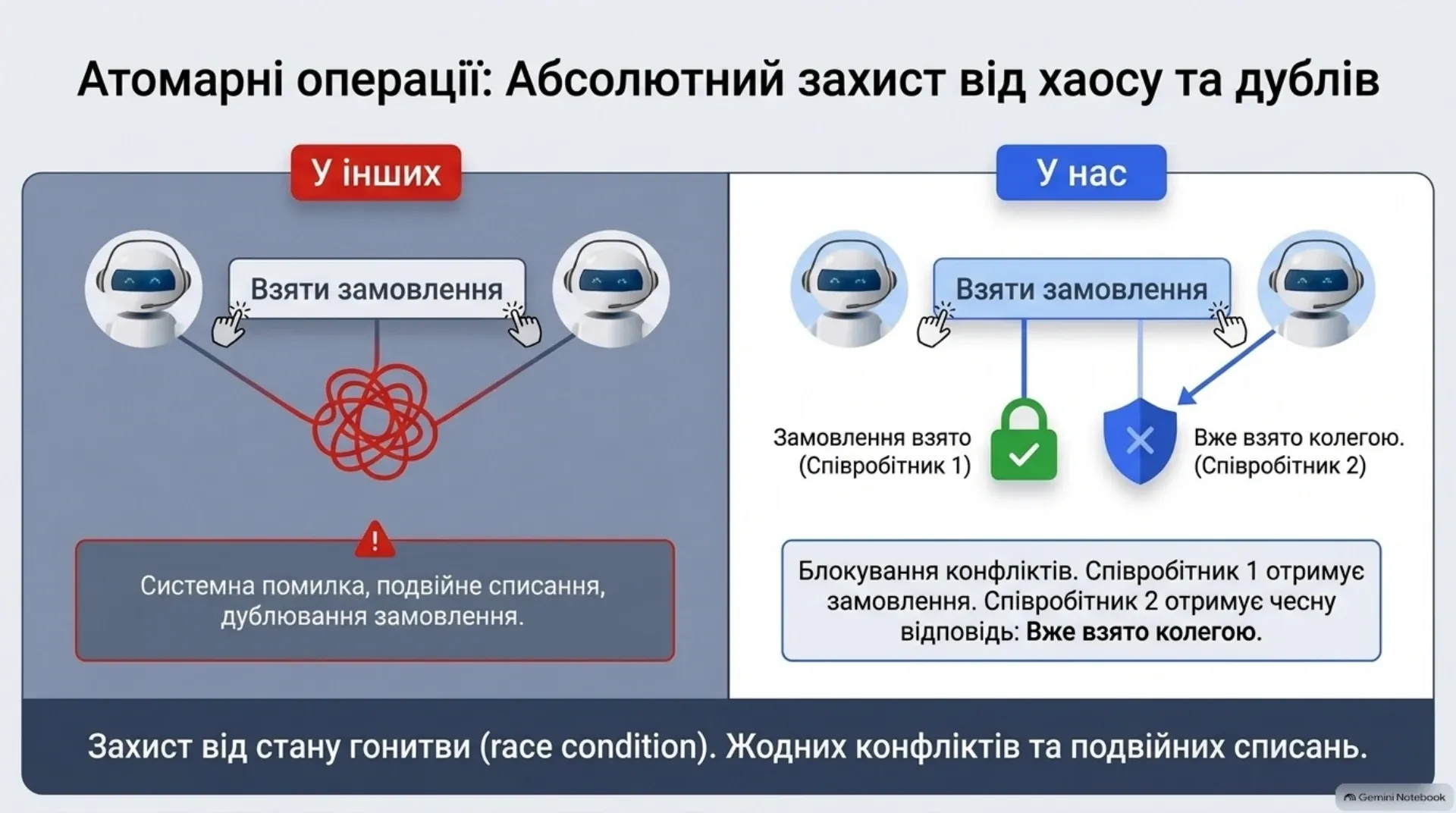
Atomic operations. Protection from race conditions: if two employees grab the same order at once, only the first gets it while the second sees an honest «Already taken by a colleague». No duplicates, no double charges.
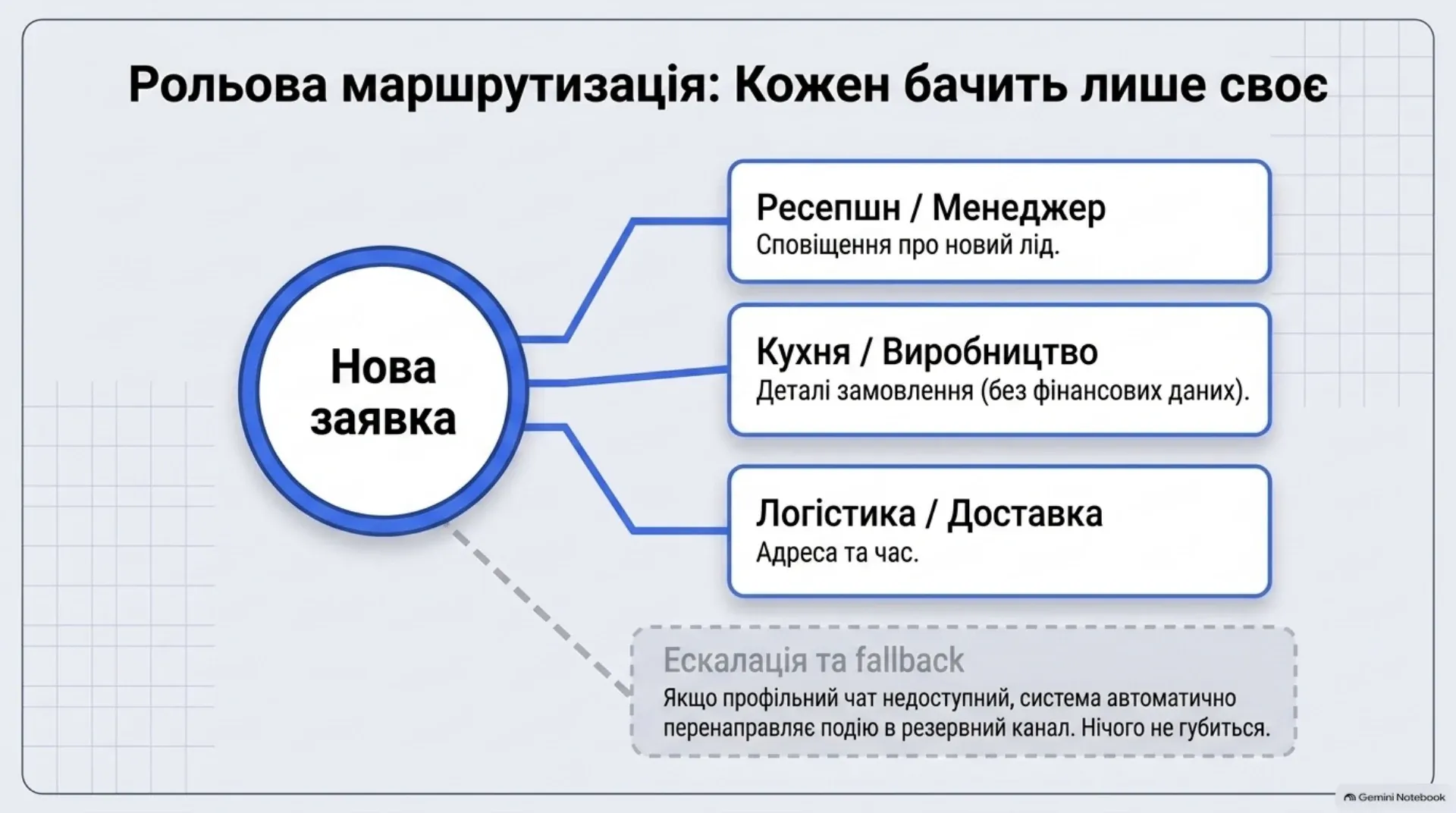
Role-based routing. Everyone sees only their scope: reception — a new lead, kitchen or production — order details without financials, logistics — address and time. If the target chat is unavailable, the event automatically falls back to a reserve channel.
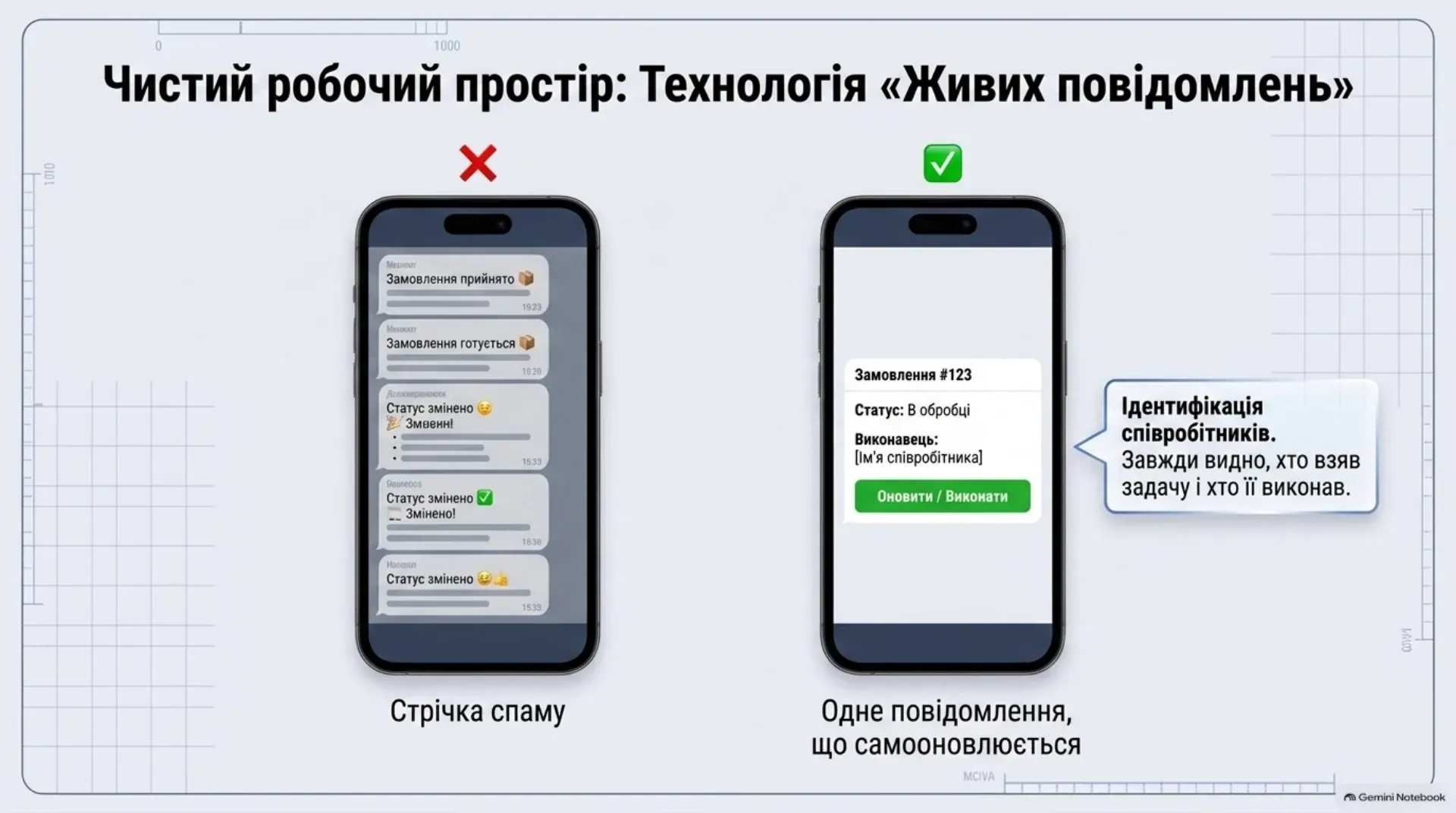
«Live messages». Instead of a spam feed — a single self-updating message with the current status and assignee. It is always clear who took the task and who completed it.
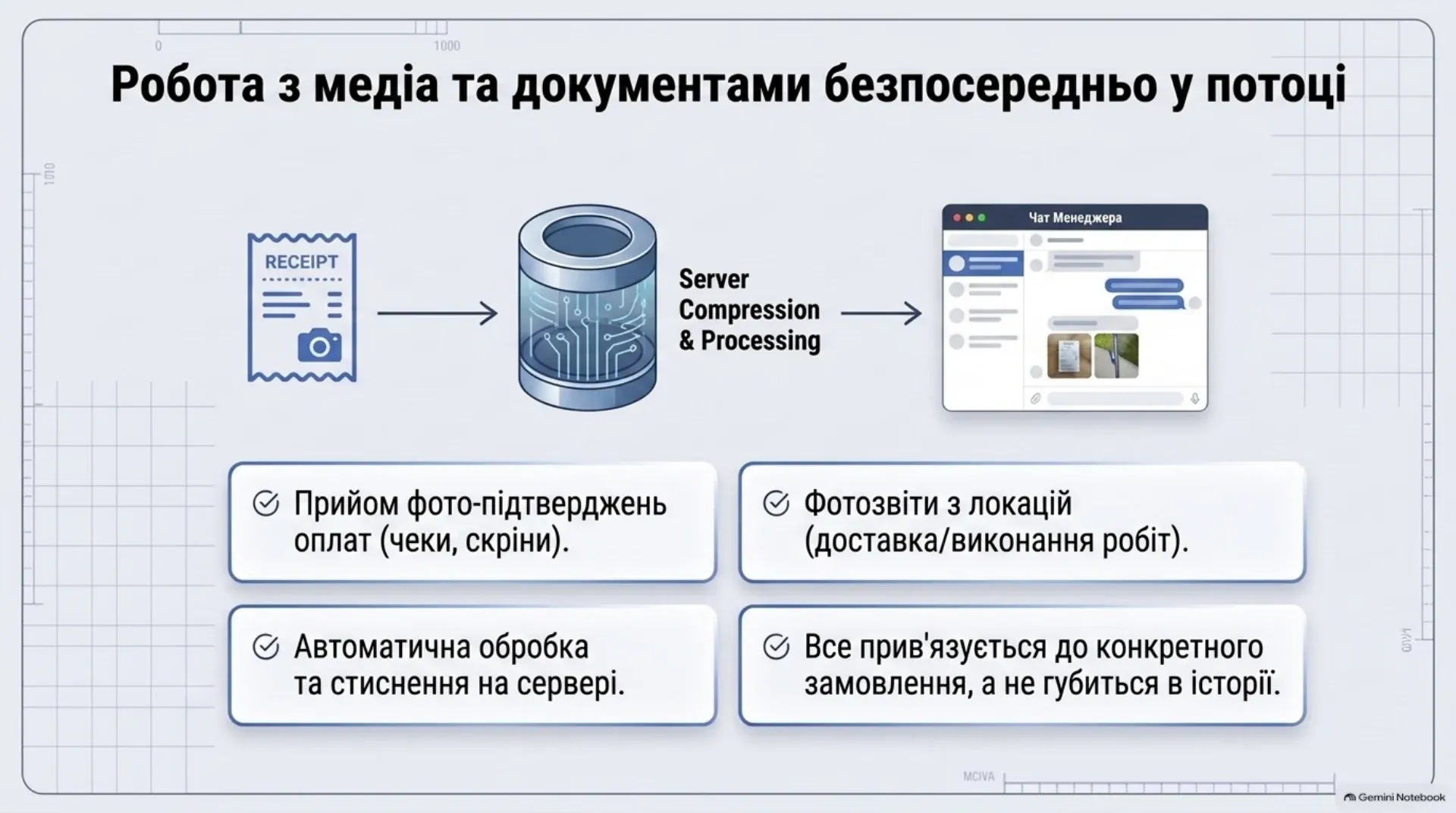
Media and documents in the flow. Accept payment photo-confirmations, receipts and on-site photo reports right in the chat; files are auto-compressed on the server and tied to a specific order rather than lost in history.
Telegram ecosystem vs a classic POS / software
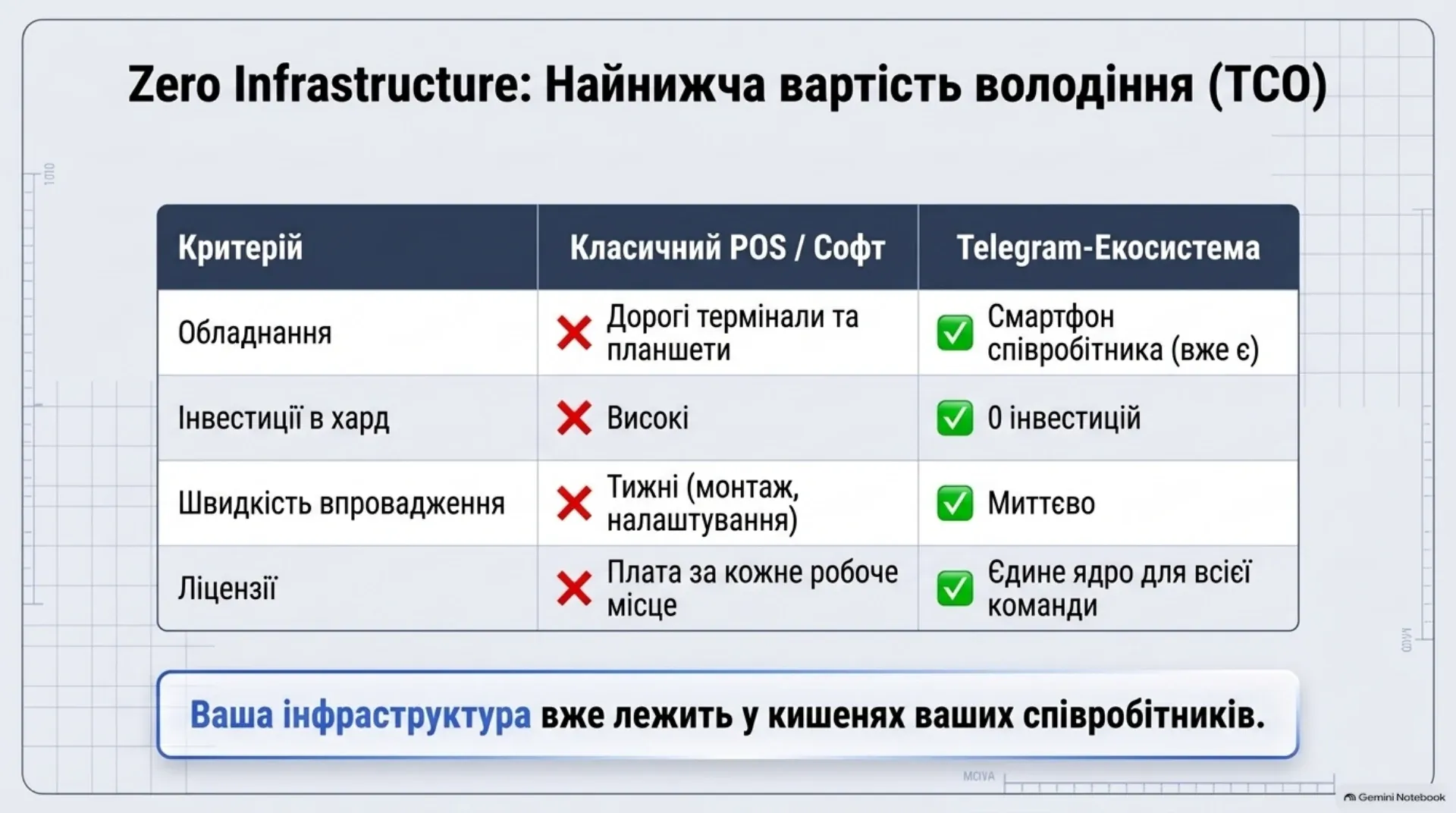
Criterion | Classic POS / software | Telegram ecosystem |
|---|---|---|
Hardware | Expensive terminals and tablets | Employee smartphone (already owned) |
Hardware investment | High | Zero investment |
Time to launch | Weeks: installation, setup | Instant |
Staff training | Courses and manuals | ~2 minutes in a familiar messenger |
Licensing | Fee per workstation | One core for the whole team |
Customer availability | Installing a separate app | 0 seconds — Telegram is already in the pocket |
Industries and scenarios
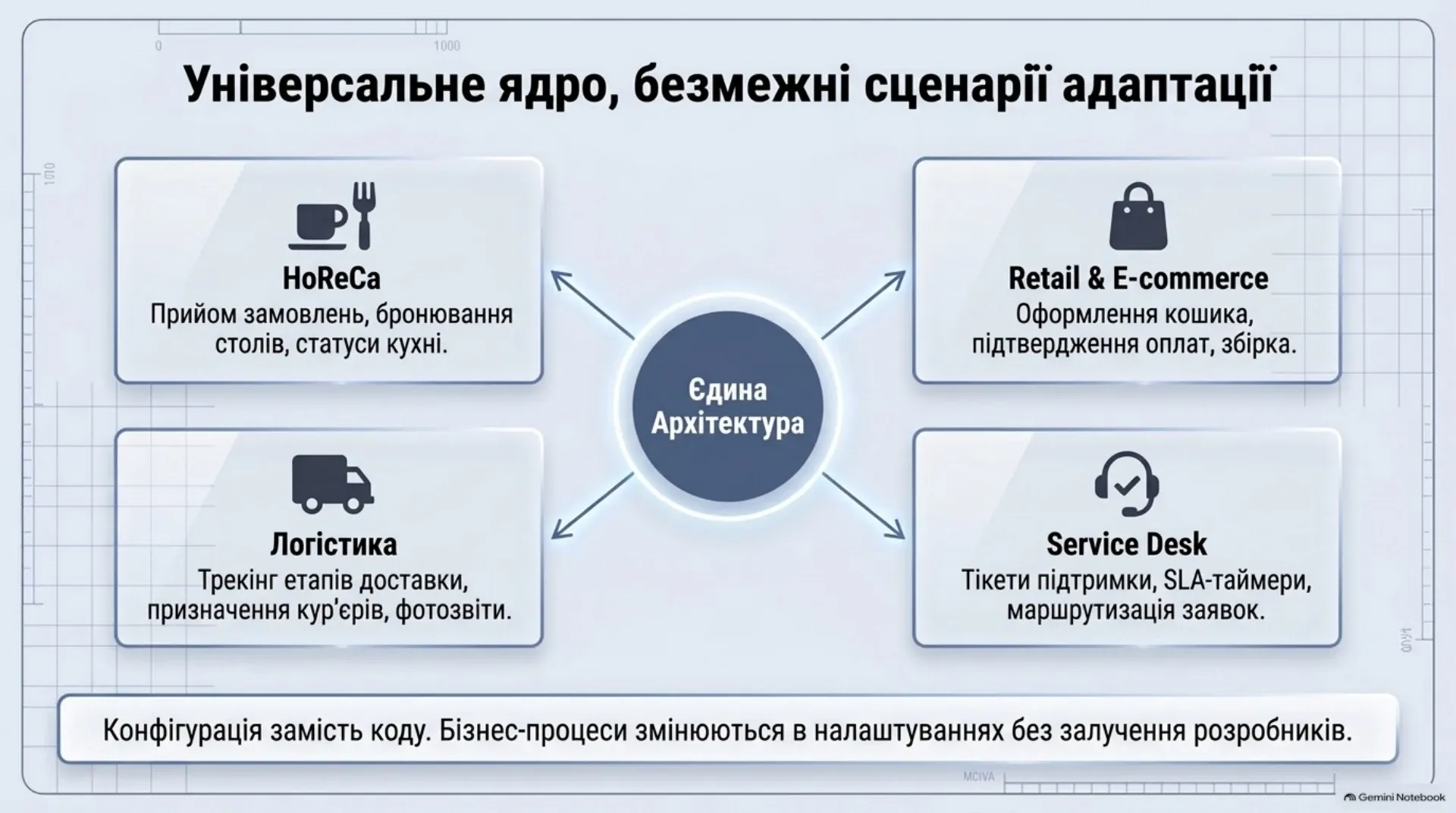
A universal core is tuned to different businesses by configuration, not by rewriting code:
Industry | What it automates |
|---|---|
HoReCa | Order intake, table reservations, kitchen statuses |
Retail & E-commerce | Cart checkout, payment confirmation, fulfillment |
Logistics | Delivery-stage tracking, courier assignment, photo reports |
Service Desk | Support tickets, SLA timers, request routing |
Scaling and evolutionary growth
Horizontally the system grows by adding new branches, teams and roles — the architecture expands linearly. Vertically new business processes are added to the same state machine (for example, a «Service» branch after «Delivery»).
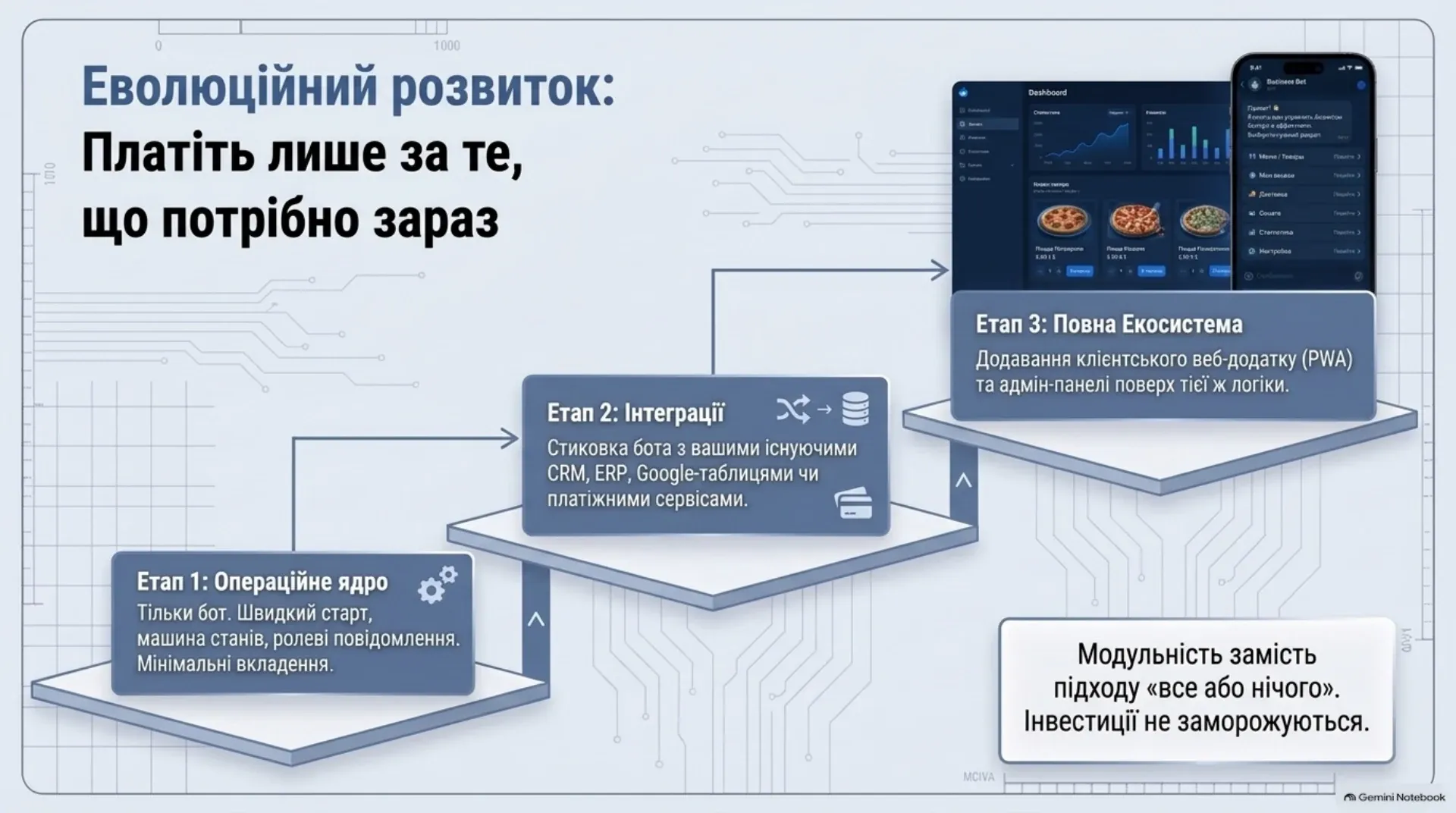
Adoption is modular — you pay only for what you need now, so investments are never frozen:
- Stage 1. Operational core — the bot only: quick start, state machine, role-based messages, minimal investment.
- Stage 2. Integrations — connecting to your existing CRM, ERP, Google Sheets or payment services.
- Stage 3. Full ecosystem — a client web app (PWA) and an admin panel with analytics on top of the same logic.
The outcome
One server runs everything — the client app, team chats and admin panel share a single backend, with no data desync between customer, staff and owner. Smart retries respect Telegram limits, while background tasks (reminders, timeouts, cleanup) run autonomously. Zero infrastructure means the lowest total cost of ownership (TCO).
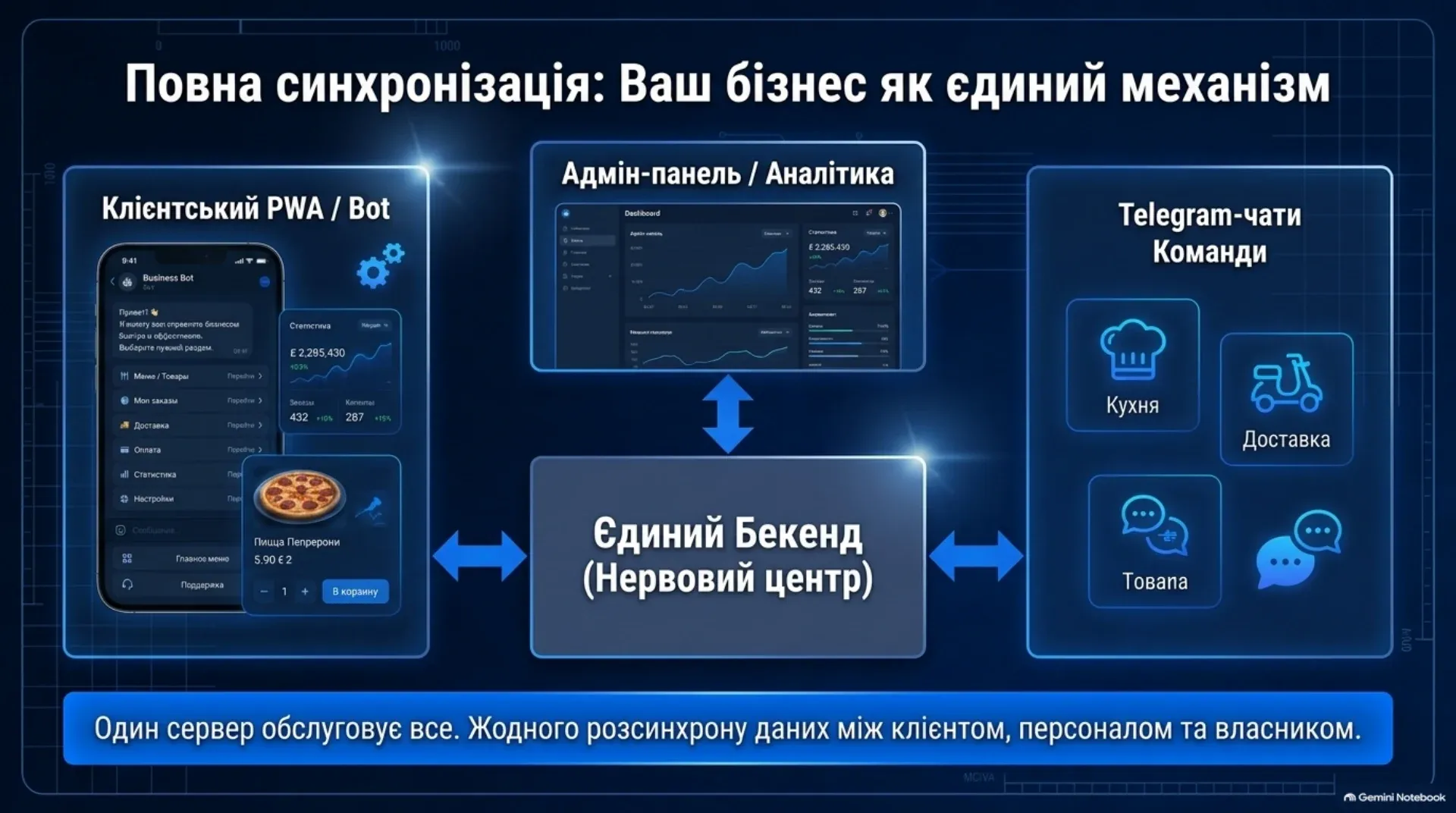
“One server runs everything. No data desync between the customer, the staff, and the owner.”